Building Secuna with a small early-stage team
Secuna started as a small team with one mission: connect Philippine startups and companies with talented local security researchers through a responsible bug bounty platform.
I was the designer on that early team. While the platform, its workflows, and its community were still taking form, I helped shape the product experience for both the companies running programs and the researchers testing them.
Connecting companies with a community of security researchers
Companies create a bug bounty program or a vulnerability disclosure program (VDP), define what’s in scope and what each finding is worth, then review incoming reports, talk with the researchers behind them, and reward the valid ones.
Researchers discover programs, read the policy and scope, and test within it. They submit what they find, answer questions, retest fixes when asked, and earn bounties and reputation.
The two sides meet in three places: the program, the report, and the reward. Secuna holds all three, including paying out bounties.
- Create program, Company
- Set scope & rewards, Company
- Program, Secuna
- Discover program, Researcher
- Test in scope, Researcher
- Submit report, Researcher
- Report, Secuna
- Review & triage, Company
- Reply & retest, Researcher
- Reward, Company
- Bounty & reputation, Secuna
- Earn & rank, Researcher
Some companies ran their programs with their own security team. Others had Secuna help manage them.
Putting the most useful information within reach
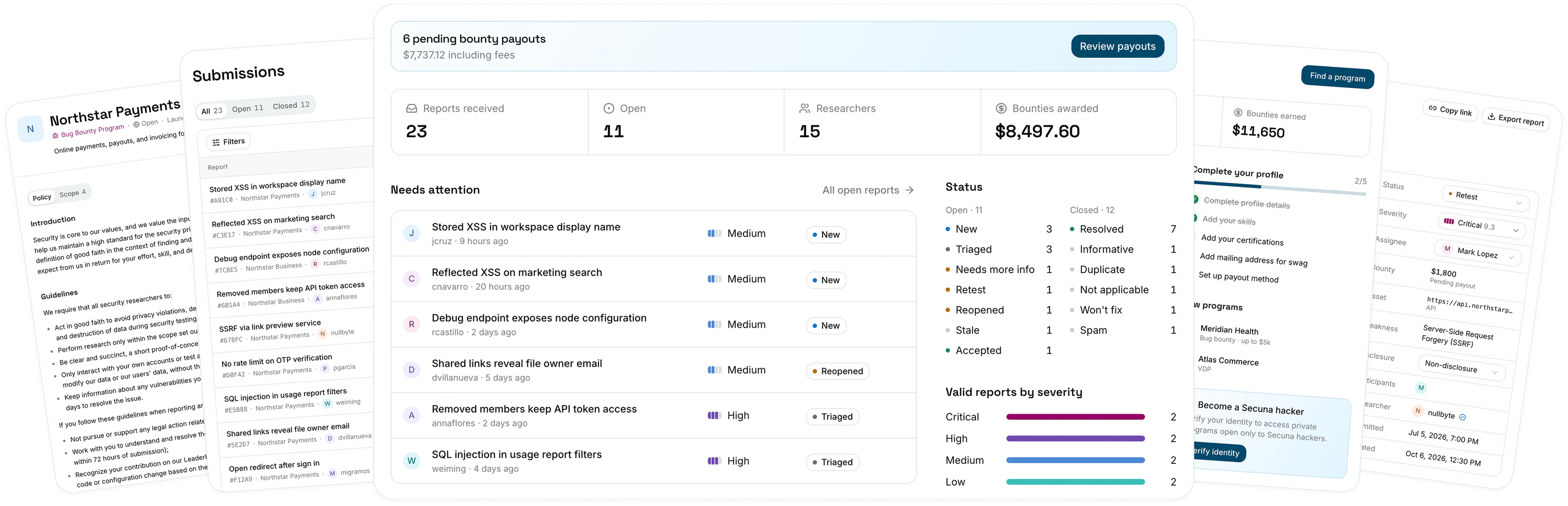
Companies and researchers come to Secuna for different reasons, so each side has its own dashboard. Both lead with the same question: what needs my attention right now?
A company sees reports received, open reports, researchers, and bounties awarded, then the reports waiting on the team, with status and severity breakdowns beside them. A researcher sees their rank, points, resolved reports, and earnings, then the reports that need a response, recent activity, and new programs to test.
Turning a vulnerability report into a working conversation
A report is where most of the work between both sides happens, so it couldn’t end at the submit button.
Researchers describe each finding in the same structure: the asset, the weakness, a severity and score, then a summary, steps to reproduce, impact, and attachments, so the company can validate it without chasing details.
From there, the report becomes a shared thread. The company team validates the finding, adjusts severity and status, assigns it, asks for more information, and awards the bounty, all in the activity history the researcher follows. Internal notes stay with the company team.
Making the platform feel active beyond individual reports
Researchers spend most of their time on one report at a time, which can make the platform feel quiet. Hacktivity and the Leaderboard show what’s happening across it.
Hacktivity is a feed of recent findings and rewards across programs. The Leaderboard ranks researchers by points and resolved reports, adding a light competitive layer and giving each researcher a sense of where they stand.
Designing both sides of the platform shaped how I thought about systems
Companies needed clarity, control, and confidence in the reports they received. Researchers needed opportunity, recognition, and a clear path to submit meaningful findings. Many decisions meant weighing one side’s needs against the other’s.
Designing both experiences showed me that the platform only works when both sides can work together effectively, and that much of the design work lives in the space between them.