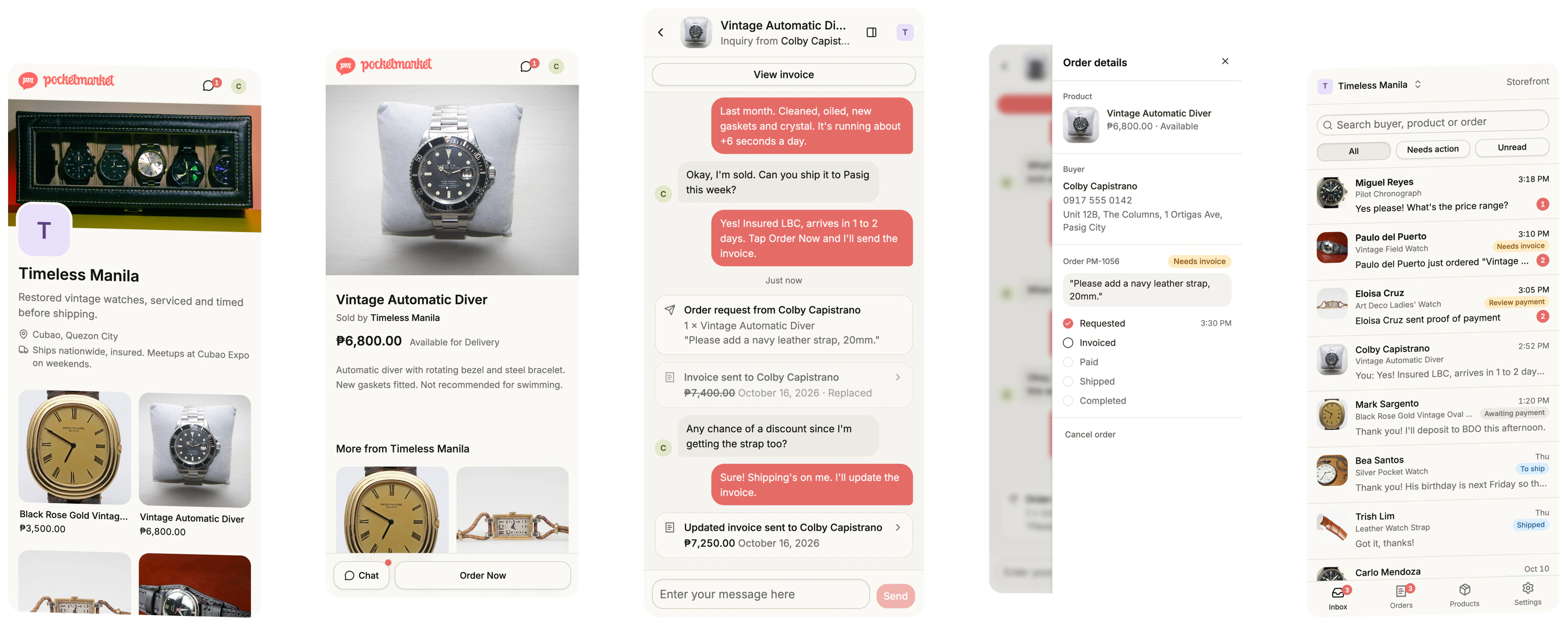
Designing the buyer and merchant experience
Pocketmarket brought product discovery, conversations, orders, invoices, payments, and fulfillment into one connected experience. I worked as the sole UI/UX Designer across both the buyer and merchant sides from 2015 to 2017.
Selling across social media was hard to manage
Posting one product across multiple social media accounts was time consuming, especially once customer inquiries started coming in through each one.
Managing payments was another challenge. Small merchants often handled confirmation manually, coordinating with buyers through messages, calls, or email. It could quickly become unwieldy.
- Facebook
- How much?
- Paid, please check.
- Still available?
- Instagram
- How do I pay?
- Is the price final?
- What condition?
- Twitter
- Ship to Pasig?
- Other colors?
- Sent my payment.
- SMS
- Can we meet up?
- Just deposited.
- Can you hold it?
- Email
- Bank details?
- Any discount for two?
- When will it ship?
The merchant had to piece the sale together across channels.
Bringing structure to conversational selling
We saw conversation and transaction as two parts of the same sale. The conversation could stay flexible, while the transaction became a shared record of what both sides had agreed.
Prices, extras, shipping, payment details, and later changes could resolve into one evolving transaction.
The goal was not to replace conversational selling, but to give it enough structure to move reliably from agreement to fulfillment.
Making fragmented payments easier to track
Payment options already existed, but the purchasing experience for small merchants selling through social media was still fragmented and often had to fit existing bank and over-the-counter payment habits.
Pocketmarket connected those payment steps back to the order. Buyers could choose payment instructions and submit proof, while merchants could review the payment against the invoice before moving the order forward.
The conversation became the record of the transaction
Every step of the transaction appeared in the same thread as the chat, including the request, each invoice, payment proof, confirmation, shipment with tracking, and the buyer marking it received.
The header showed each side its next step. For the buyer, that moved from waiting for an invoice to paying, then confirming receipt. For the merchant, it moved from sending an invoice to reviewing payment, then shipping.
A thread for each transaction, and a view across all of them
Merchants needed a way to see everything happening across the store. We connected those threads into a broader operational view so they could move between conversations, see which orders needed attention, and understand where each transaction stood.
A Chat-App-Agnostic Approach
Our early approach was to bring conversations into Pocketmarket so the whole transaction could live in one place. Through testing, observation, merchant feedback, and what we learned from how people actually used the product, we realized many merchants still preferred the chat apps they already used every day.
That changed our direction. Instead of asking merchants to move their conversations into Pocketmarket, we started bringing Pocketmarket’s commerce tools into the conversations they were already having.
This led to a more chat-app-agnostic approach, where the commerce layer could work within a merchant’s preferred messaging app rather than requiring Pocketmarket’s own chat.